

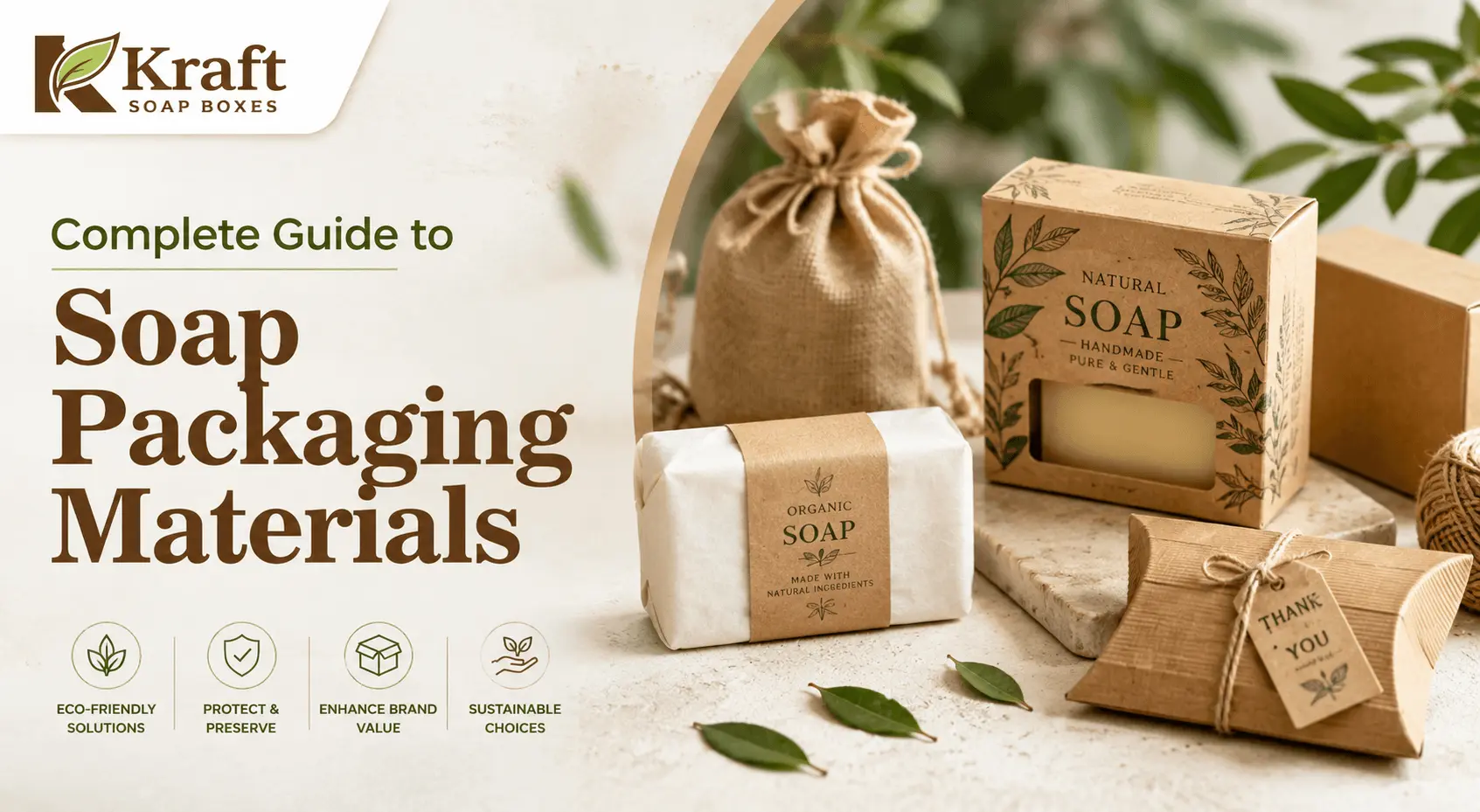
Have you ever noticed a bar of handmade soap inside a box? Such a packaging is usually made of paper such as kraft, cardboard, or corrugated board. Sometimes soap bar comes in special box to make sure the product is well protected.
A quality packaging is also eco-friendly because it is biodegradable. Some soap boxes are available in FSC-certified paper. Moreover, many packages contain recyclable materials. Packaging also makes the soap-moisture resistant.
The packaging material for the soap refers to the materials used to cover the bar. It should be wrapped in an attractive and premium paper or box.
You need to be aware of two packaging types:
It covers the product or soap bar and is the first that customers see. It forms the first layer of protection.
Secondly, there is the secondary packaging, which is the external package that contains the already packaged soap. An example would be a gift box containing five soaps.
Both of the above are extremely important. Choosing the correct materials for both packaging will determine whether or not your soap enterprise succeeds.
Well, there are different types of materials and they act differently. However, they protect bars and provide long time storage. Soaps are sensitive to moisture so they must offer protection from humidity. It needs to preserve their freshness and smell so packaging must be fragrance retention. These materials have UV and heat resistance to protect it from sun and heat damage. It also ensures product hygiene and contamination prevention, so dirt and germs cannot enter.
Before you pick a packaging material, you need to think about a few important things. Not all soaps are the same, and not all packaging works for every type of soap.
The kind of soap you have matters a lot when choosing packaging. Here is a quick breakdown.
It tends to have an organic feel to it. Kraft paper or cloth wrappers are perfect for such products.
Requires organic packaging due to its natural properties.
This is an olive oil-based, mild soap. The package should be clean but elegant.
Is usually transparent and very attractive. Packaging can also have a see-through effect to enable consumers to view what’s inside.
Has a rugged appearance. Darker packaging will do the trick in this case.
It has its roots in Africa and is organic. The packaging should reflect its rugged nature.
Requires packaging that appears clean and credible.
Comes in a container and is used in bathrooms. Hence, the best choice would be a tin or a rigid cardboard box.
Requires packaging material that is safe, durable, and protected.
Require premium packaging, e.g., rigid box with finish.
An increasing number of consumers are conscious of environmental issues. Packaging that can either be recycled, composted, or sourced from sustainable sources does not only have an environmental benefit – it is also a win for your brand. Consumers love environmentally conscious brands.
The packaging material of your soap products will be the equivalent of an advertisement billboard for your brand. You want to ensure that your brand and product information can be easily printed on the package material.
Are you retailing in stores, or is the packaging required for shipping e-commerce orders? The former must be aesthetically pleasing while the latter must be able to withstand shipping stress without getting damaged.
There are five main types used in soap packaging. Each one has its own strengths and weaknesses.
Kraft paper is an extremely strong brown paper which is manufactured using wood pulp. You have likely come across kraft paper in grocery bags or shipping paper. This type of paper has a natural, rustic appearance which makes it very popular.
The Kraft soap paper will degrade on its own when left outside without interfering with nature. In other words, the kraft paper degrades quickly and does not remain in landfills for several decades as happens with the plastic material. Additionally, kraft paper can be easily recycled for environmental benefits.
This type of paper is known for having a natural appearance which makes it ideal for use in packing handmade or organic soaps. It adds warmth and coziness to the soap packaging.
Another advantage of the kraft paper packaging is that it is very lightweight, thus minimizing the overall package weight. This could potentially lead to reduced shipping costs. Moreover, kraft paper is inexpensive as compared to other materials.
Kraft paper is surprisingly durable. It has long, sturdy fibers, which make it resistant to tears.
Standard kraft paper tends to get soggy when it gets wet. Unless it has been coated, it will provide little resistance to moisture, meaning that it won’t keep your soap dry.
Foil stamping, among other types of luxury finishing techniques, do not work as effectively on kraft paper as they would on other materials.
Cardboard is a form of paper that is thicker in nature than regular paper. Cardboard or paperboard is used to make small boxes, such as the packaging of cereal or even cell phones. It is a highly common packaging material.
Cardboard is a highly ideal printing medium due to its plain white surface, which enables high-quality color printing.
Customizing cardboard soap boxes in various shapes and sizes is fairly simple; you could have a hexagonal box, a sleeve package, or even a window display box.
Like kraft paper, cardboard is not very heavy. This keeps shipping costs manageable.
It is one of the most cost-effective options for packaging.
Just like kraft paper, standard cardboard does not survive in water. This material could be deformed, deteriorate, or grow fungi because of excessive moisture exposure.
Cardboard is less durable compared to corrugated paper or boxes. In cases where items are bulky or need to travel great distances, cardboard may not provide adequate protection.
Corrugated board, on the other hand, is used to produce the heavy-duty packaging boxes that offer protection for the soap. These have a fluted layer in between flat layer. This gives the material excellent protective qualities.
Depending on the type of protection required, different types of corrugated board are used. The options include:
Corrugated board packaging is perfect for protecting soap shipments. The fluted layer acts as cushioning, which helps to absorb any shock while in transit.
Boxes can be set together and this causes compression. With corrugated board, this problem is easily handled due to its compressive qualities.
If you need to ship many bars of soap at once, corrugated boxes are ideal. They are designed for bulk use and can hold a lot of product safely.
These types of boxes tend to be bulky compared to the thinner cardboard and paper packages. This becomes problematic when there is little available storage space.
Corrugated boxes look very much like “shipping boxes.” They do not possess an especially attractive appearance for either retail presentation or gift wrapping.
Rigid packaging comprises those boxes that you will find in very sophisticated gift shops. Such packages consist of firm boards and can’t be collapsed into a flat form. Imagine the packages in which jewelry pieces or luxurious perfumes are delivered.
Luxurious packaging is instantly recognizable. When customers open the package with their hands, they will know that they are dealing with premium quality.
Given its stiffness and firmness, a rigid packaging guarantees that the contents will not suffer any damage when shipped.
“Unboxing process” became an essential part of modern life. Many people enjoy unboxing gifts in front of their cameras to share on social networks.
Manufacturing rigid boxes is more expensive compared to corrugated boxes and Kraft papers since they take more time and material to be produced.
They are denser, and their weight is higher; therefore, they will result in an increase in shipping costs.
Simplicity sometimes wins out when it comes to packaging. Minimal packaging includes paper wraps and sleeves which are only able to cover the soap partially.
This will result in minimal waste, which is beneficial for the environment as well as for shoppers who are environmentally conscious.
Minimal packaging will require less material, making it cost-effective. This approach should be considered by startups or small companies that cannot afford much.
Wrapping with a stamped logo or tying with twine will look beautiful and unique, adding value to your brand as an artisan product.
As wraps are open-top packaging and belly bands do not cover all the soap, there may be a risk of damage from moisture and loss of scent.
Minimal packaging will be less tamper-proof, making it a potential problem for the retailer and customers from a hygiene perspective.
Green packaging is not a mere trend; it is the way forward! Here are some of the most eco-friendly soap packing solutions to opt for if you manufacture soaps.
These include materials that will eventually decompose in the natural environment, such as uncoated kraft paper and plant-based films.
These materials are similar to the biodegradable ones except that they decompose faster and can be converted into compost material for gardening.
Paper cartons, kraft papers, and some types of boxes made from rigid cardboard can be recycled at home easily.
This certification comes from the Forest Stewardship Council. The council certifies packaging materials sourced sustainably from the forest.
These forms of ink do not contain any chemicals as opposed to regular inks.
Here is a handy table that puts all five main materials side by side so you can compare them at a glance:
|
Material |
Sustainability |
Durability |
Moisture Resistance |
Print Quality |
Cost |
Best For |
|
Kraft Paper |
High |
Medium |
Low–Medium |
Medium |
Low |
Handmade soap |
|
Cardboard |
Medium |
Medium |
Medium |
High |
Low |
Retail packaging |
|
Corrugated Board |
Medium |
High |
Medium |
Medium |
Medium |
Shipping |
|
Rigid Boxes |
Medium |
Very High |
High |
Premium |
High |
Luxury soaps |
|
Paper Wraps |
High |
Low |
Low |
Medium |
Very Low |
Minimal packaging |
As you can see, no single material is perfect for everything. The best choice depends on your soap type, budget, and brand goals.
Your packaging is your brand's face to the world. Here are the ways you can make it look amazing:
There are various printing techniques that are used on these materials.
To create more attractive packaging, it is excellent to add finishes to the soap packaging. There are unlimited custom combinations available to offer a premium feel.
Die-cut windows help shoppers see the bar without unboxing while inserts ensure that the soap remains secure inside the box.
Even experienced soap makers make packaging mistakes. Here are the top ones to watch out for:
Cheap is not necessarily good when it comes to packaging. If the packaging is not made with a strong material or is inferior, then it will break easily. This factor leaves a negative impact on your brand.
Soap and moisture cannot stay together. Humidity or dampness ruins your soap. Thus, to avoid this issue, your packaging must be moisture resistant.
If your packaging destroys during storage and delivery, then it is a waste of money. That is why; you must choose sturdy material and add inserts for extra protection.
Attractive packaging that gets damaged during shipping does not make sense financially. Your packaging must be able to withstand transportation.
Your packaging should reflect your brand’s identity. Putting luxurious soap in an old brown paper bag would be counterproductive.
The packaging world is always changing. Here are the biggest trends happening right now:
Simple but unique designs create a long-lasting impact on your brand. It is good to focus on choosing minimalist designs for a memorable effect in packaging.
Companies are trying their very best to make their packaging processes completely waste-free.
Some brands are providing refillable packaging wherein the consumer keeps the box and just buys the refill soap bars.
Protective layers allow barrier coating with the ability for complete composability.
All you need is a QR code placed strategically on your soap box, and you can share product information and tutorials.
There are many colors that are suitable for soap boxes. You can choose natural tones like brown, terracotta, and many others.
There are many options from which you can choose your packaging materials. Here are expert picks for different situations:
They have an attractive appearance and are made of eco-friendly materials.
Sturdy boxes with foil stamping or embossing. There is nothing like a robust, professionally designed box that conveys luxury.
You can select belly bands or wrappers for this type of soap. These are unique and cost-effective options. It is easy to add stickers to the wrapper or band.
Corrugated boxes for external packaging with cardboard boxes inside. They are strong enough to withstand the postal system process and are customizable.
Cardboard sleeves are the best choice for this. These sleeves are easy to design and affordable.
Soap packaging is not a simple thing to do because soaps are sensitive in many ways. That is why it is important to choose the appropriate material that can protect and keep them fresh for longer. For the soaps of all types, it is important to focus on eco-friendly materials that boost brand image as well. Moreover, it is important to consider soap type, customization options, and budget while choosing the materials.
It depends on what kind of soap you have and what your intentions are for that soap brand. Homemade soap brands use Kraft paper while luxury brands should opt for rigid boxes.
Yes! It is an excellent material used by many because it is environmentally friendly, economical, and adds an artisan look to your soap products. You just need to put a moisture barrier on if it’s a problem soap.
One of the most environmentally friendly materials for packing soap would be the compostable plastic wrapping, as well as certified Kraft paper.
With the moisture-resistant finishes, it is easy to save your soap boxes from dampness. Moreover, you can close them with a tight lid, and wax paper layers make them completely waterproof.
Yes, they are. It is easy to recycle the paperboard that has no coating on it. For more options, you can consult with your packaging supplier.
Wraps of Kraft paper, tissue paper, or belly bands would be great choices for handmade soaps, which would add to the handcrafted nature of the products.
Paper wraps and belly bands would be the most inexpensive solutions because they require minimal material and are easy to manufacture.
Yes, there are many examples of biodegradable materials used in the production of packaging solutions for soap.

Kraft Soap Boxes helps businesses reduce their environmental impact with custom eco-friendly packaging solutions. Choose sustainable packaging that supports your brand while building a greener future—one package at a time.
 COMPANY INFO


© 2026 - Kraft Soap Boxes. All Rights Reserved


